

The Randolph County Recycling Center will be temporarily closed.

Recycling Facts

Randolph County Solid Waste Authority

At Randolph County Solid Waste Authority, we gathered up some of our favorite fun and interesting recycling facts for you. We think you might appreciate them as much as we do!
  1. If you throw away an aluminum can today, it will remain a can 500 years from now.

  2. In 2018, over 52 million tons of paper was recycled.

  3. Over 80,000,000,000 (eighty trillion) cans are recycled each year.

  4. Every 3 months, Americans send enough aluminum to landfills to build all commercial airplanes in existence.

  5. There is no limit to how many times we can recycle aluminum.

  6. Throughout a lifetime, the average person encounters 25,000+ recyclable aluminum cans.

  7. Recycling 1 ton of paper spares 17 trees.

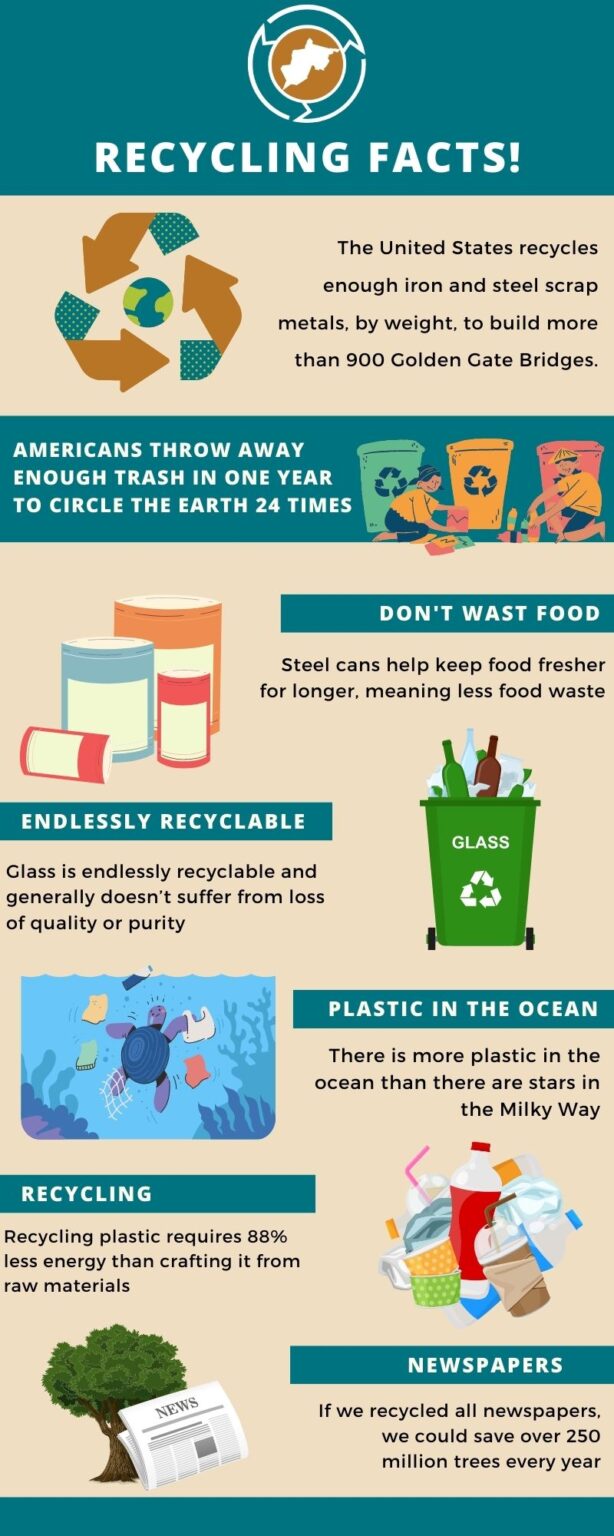
  8. Americans throw away enough trash in one year to circle the earth 24 times

  9. Steel cans help keep food fresher for longer, meaning less food waste

  10. Around one third of landfill space is taken up with packaging materials

  11. Glass is endlessly recyclable and generally doesn’t suffer from loss of quality or purity

  12. The United States recycles enough iron and steel scrap metals, by weight, to build more than 900 Golden Gate Bridges.

  13. Every year, 2.4 million tons of recycled glass are used to make new bottles and jars

  14. 75% of all aluminum produced in the US is still around today

  15. There is more plastic in the ocean than there are stars in the Milky Way

  16. Recycling just one ton of paper saves 7,000 gallons of water.

  17. Americans will use over 2 and a half million plastic bottles every thirty minutes, and most of them are simply thrown away rather than recycled.

  18. Every three months, Americans throw enough aluminum in the landfills to build our nation’s entire commercial air fleet.

  19. Recycling prevents waste from going into oceans – it is proven, when there is a strong recycling culture, there is less litter and less waste going into oceans.

  20. Americans throw away enough office paper each year to build a 12 foot high wall from Seattle to New York (a new wall every year).

  21. Making glass from recycled material cuts related water pollution by 50%

  22. 2.5 million plastic bottles are thrown away every hour in America

  23. Each ton of recycled paper can save 17 trees

  24. Recycling plastic requires 88% less energy than crafting it from raw materials

  25. Nearly half of food in America goes to waste

  26. One metric ton of electronic scrap from personal computers contains more gold than that recovered from 17 tons of gold ore.

  27. Plastic bottles are often recycled into downgraded products, like carpet and fiberfill for jackets.

  28. Recycling 1 ton of cardboard saves 46 gallons of oil.

  29. 80 billion pounds of food is thrown away in each year

  30. Nearly 1 billion trees worth of paper is thrown away each year

  31. More than $161 billion is lost each year to food waste

  32. If we recycled all newspapers, we could save over 250 million trees every year
Recycling Facts

A Shocking 91% of Plastic Is Not Recycled

Our Oceans Now Contain Large Floating Garbage Patches

Our planet has 5 huge gyres (garbage patches) floating on our oceans. The largest one, the Great Pacific Garbage Patch, is over 1.6 million square kilometers in size –that’s twice the size of Texas.

5 Gyres of Plastics and Synthetics

The five gyres are: the North Atlantic Gyre, the South Atlantic Gyre, the North Pacific Gyre, the South Pacific Gyre, and the Indian Ocean Gyre. About half of the mass consists of synthetic fishing nets and the remainder is mostly plastic bottles and waste.

The Ocean Cleanup

Now, the goal is to get rid of plastic from our oceans – and keep it out. You can visit The Ocean Cleanup website to learn more about the largest cleanup effort in history and how you can get involved.

Waste Management & Recycling In Randolph County, WV

Randolph County Solid Waste Authority

Whether you’re interested in options to handle your household trash in Mill Creek, managing waste collection for your business in Beverly, or collaborating with concerned scientists and citizens to help cleanup the largest patch of ocean garbage in the world, your efforts demonstrate good citizenship. That is something you can take pride in. Thank you for visiting our website. At Randolph County Solid Waste Authority, we appreciate you taking the time to learn more about proper waste management in Randolph County, WV, and beyond. If you have questions or concerns, please contact us for assistance.

Annual Adopt-A-Highway Spring Cleanup set for April 25th

The West Virginia Department of Environmental Protection (WVDEP) is now accepting registrations for the Adopt-A-Highway Spring Statewide Cleanup set for Saturday, April 25, 2026.

Individuals, families, churches, businesses, schools, civic organizations, government agencies and communities can register to pick up trash on almost any state-maintained road, back road or main route. Private roads and interstate highways are not eligible for adoption.

The Adopt-A-Highway program provides garbage bags, work gloves and safety vests to volunteers, and takes care of disposing of collected trash. Volunteers must be at least 12 years old to participate.

Groups must register in advance by April 17, 2026, and inform their county DOH garage if they need supplies. To register, call 1-800-322-5530 or email dep.aah@wv.gov . If you reach the REAP voicemail, please leave your name, phone number, group name, date of cleanup, number of participants, and the county where your adopted road is located.

The 2025 Adopt-A-Highway Spring Cleanup had more than 1,900 volunteers from over 250groups who removed nearly 79,000 pounds of litter from almost 600 miles of roadway.

Co-sponsored by the WVDEP and the state Division of Highways, the Adopt-A-Highway program is administered by the WVDEP’s Rehabilitation Environmental Action Plan (REAP).The REAP program empowers citizens to take ownership of their communities by providing technical, financial, and resource assistance in cleanup and recycling efforts.